


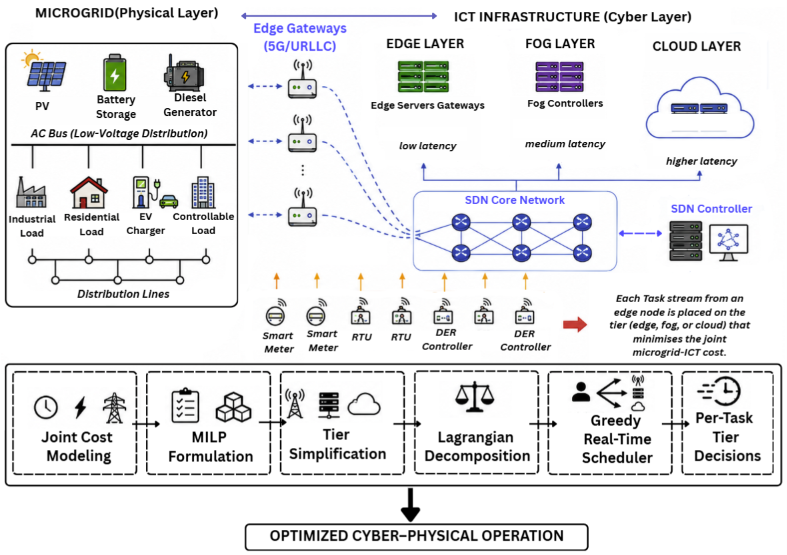
This research looks at how smart microgrids can manage the large amount of information generated by devices such as solar panels, batteries, EV chargers, sensors and controllers. The main challenge is deciding where this information should be processed: close to the microgrid at the Edge, at an intermediate Fog level, or in the Cloud. Processing information closer to the microgrid can reduce delay, but Edge resources have limited capacity, while the Cloud has more computing resources but can introduce greater communication delay and congestion. The research therefore studies how these tasks can be distributed across the three levels while considering speed, energy consumption, network capacity, and reliable operation of the microgrid, particularly for applications that require very fast communication.
The paper was recognised with the Best Paper Award at the IEEE RTSI conference 2026.
Outline the paper
This publication presents a Ultra-Reliable Low-Latency Communications (URLLC)-aware co-optimisation framework for microgrid and ICT systems, focusing on how monitoring and control tasks in smart microgrids can be efficiently distributed across Edge, Fog and Cloud computing resources. The research jointly considers microgrid operating costs, ICT energy consumption, communication latency, network capacity and URLLC requirements rather than optimising the power and ICT systems separately. The proposed framework uses a MILP model, a Lagrangian dual decomposition and a low complexity greedy heuristic to determine suitable task placement decisions.
What does this mean for industry and society?
The research has potential real-world implications for smart microgrids that use renewable energy, batteries, EV chargers, and other distributed energy resources. By deciding where monitoring and control tasks should be processed across Edge, Fog, and Cloud, the proposed approach can reduce communication energy consumption and latency, lower network congestion, and support faster and more reliable grid control. This could be particularly useful for time critical applications such as protection, inverter control, fast-frequency regulation, and DER coordination, where delays of only a few milliseconds can affect grid stability and resilience.
What are the next steps?
The next steps of this research are to validate the proposed framework using real microgrid and ICT data and to further test its performance under practical operating conditions. Future work can include packet level network simulation, consideration of renewable energy and communication uncertainties, modelling of communication or device failures and eventually hardware-in-the-loop or real world experimental validation.
Publication Title: URLLC-Aware Microgrid-ICT Co-Optimisation across an Edge-Fog-Cloud Continuum
Authors: Surya Jayakumar and Dr Indrakshi Dey
Name of conference: IEEE RTSI 2026 Conference
Conference Date: 16-18 August 2026