


The rapidly expanding Internet of Things (IoT), featuring billions of heterogeneous devices across smart cities industrial automation and remote healthcare, faces unprecedented challenges in managing vast dynamic and resource constrained networks. As deployments grow in size and diversity, IoT networks must operate under strict energy limits while meeting application requirements on reliability data fidelity and timeliness.
Imagine a city-wide network of sensors trying to send data back to gateways, but each sensor has limited battery power and the wireless links are often weak or uncertain. This research shows how the network can first estimate where devices are located and then use that information to decide which links should be active, how strongly each device should transmit and how data should be coded. By combining those steps, the system becomes better at avoiding unreliable links and wasting less energy.
Outline the paper
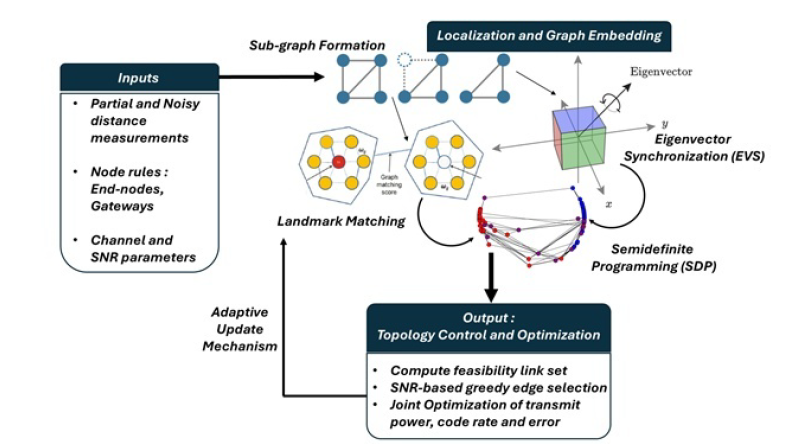
This paper presents IoTNTop, a new framework for designing large-scale IoT networks that are both reliable and energy efficient. It focuses on how sensors and gateways can be positioned, connected and managed when links are noisy, devices are heterogeneous and energy is limited. It combines node localization and topology control in one process, helping the network choose better links, power levels and code rates even when measurements are partial and noisy.
What does this mean for industry?
The real-world value is in making IoT systems more dependable at scale. In smart cities, environmental monitoring, industry and healthcare, networks must keep sending accurate data even when devices are spread out, battery powered and exposed to interference. The paper shows that IoTNTop can keep symbol error probability below 15% for most nodes while retaining roughly 60-80% of the initial per-node energy budget, which suggests longer device lifetime and more robust performance. For industry, that can mean fewer dropped messages, lower maintenance costs and better use of low-power infrastructure in large deployments.
What are the next steps?
The next steps are to test the method under more dynamic and realistic conditions. The paper highlights future work in adaptive re-embedding when channels change over time or nodes move, field trials with heterogeneous hardware and better handling of bias in measurements such as persistent non-line-of-sight effects. The authors also plan to explore hybrid learning-based methods that can warm-start edge selection while preserving the framework’s reliability-focused guarantees. Together, these steps would help move the approach from simulation toward real deployments.
This paper is supported by HORIZON-MSCA-2022-SE-01-01 project COALESCE under Grant Number 101130739 and HORIZON-HLTH-2024-ENVHLTH-02-06 project ENACT under Grant Number 101157151.
Publication Title: Optimized topology control for large-scale IoT networks using graph-based localization
Authors: Dr Indrakshi Dey and Dr Nicola Marchetti
Name of Publication: Scientific Reports – Nature
Link to Publication: https://doi.org/10.1038/s41598-026-43621-6
Publication Date: 2026 (article in press; accepted 5 March 2026)